
We may earn revenue from the products available on this page and participate in affiliate programs.
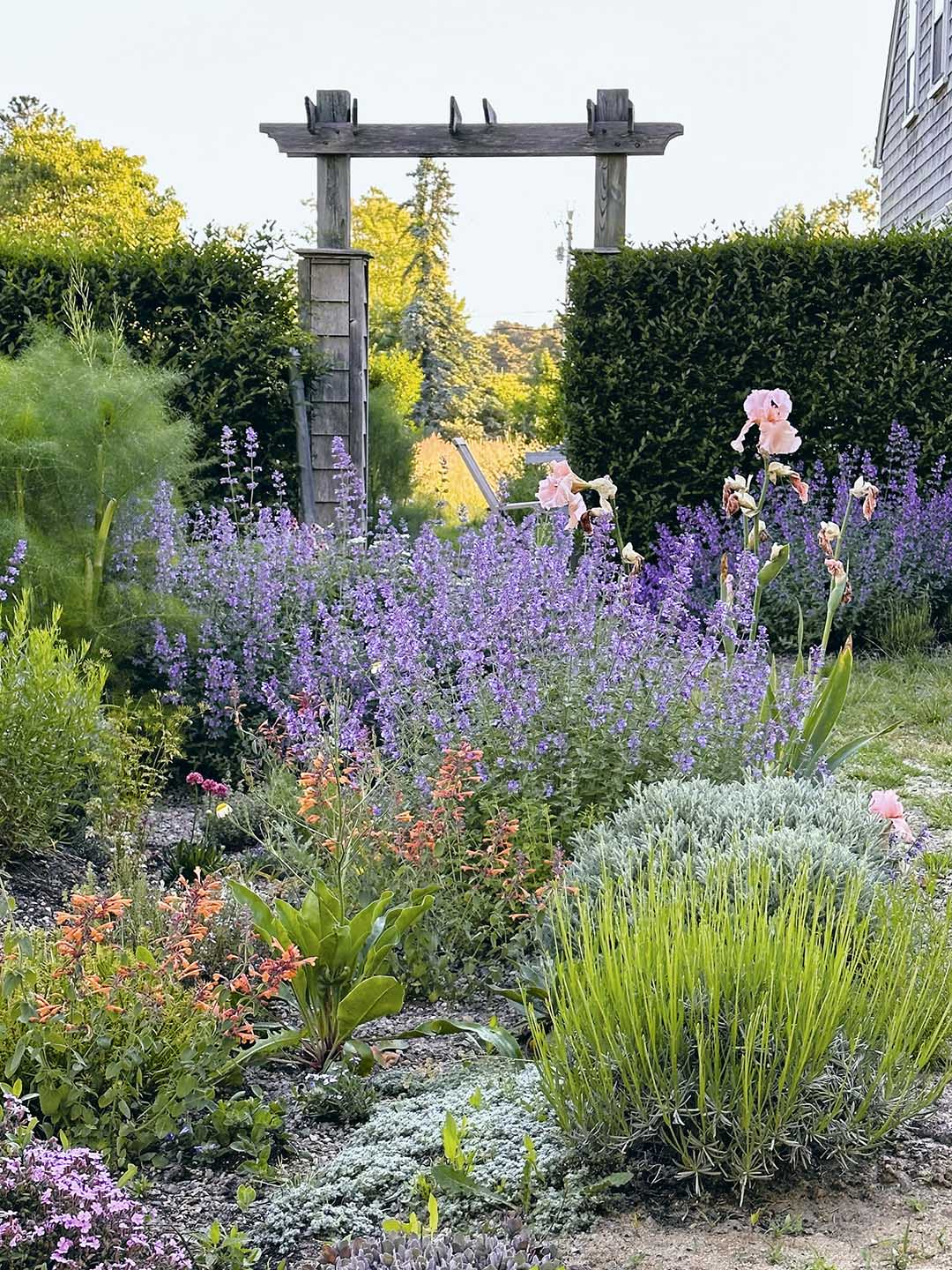
In his new book, former editor-in-chief of Better Homes & Gardens Stephen Orr takes a firsthand approach to gardening, sharing essays about his lifelong horticultural pursuits and tips from all those years of experience. And in this chapter of the book he is exclusively sharing with Domino readers, Orr reveals more about the style of his own seaside garden in Cape Cod, called a stone garden or gravel garden, a “waterwise” tradition that works well in places that get lots of rain—or very little.
Creating a gravel garden of plants that would be happy in a layer of silvery pea gravel has been a dream of mine for decades. My obsession began early with the front yard of a woman who lived down the street from us in the West Texas town where I grew up. Contrary to all the keepers of trim green lawns on our street, Mrs. Ramsey topped her yard in gravel and dotted it with agaves and prickly pears, twisted mesquite trees, and a sequence of seasonal flowers, including California poppies and poppy anemones in spring. There’s something dramatic about the spare simplicity of plants poking up, seemingly randomly, through a mulch of stone. I was drawn to the otherworldly appearance of her plantings—so much so that I felt I had to possess some of that beauty. I snuck down early one spring morning to snip all her anemones and a fair portion of her larkspurs, which I hid in our doghouse. I was quickly found out by my mom, who must’ve wondered what I was doing out there. She forced me to return the limp stems to Mrs. Ramsey, which I did tearfully. I remember her only as a shadowy figure in a doorway wearing cat-eyed glasses above a grim mouth.
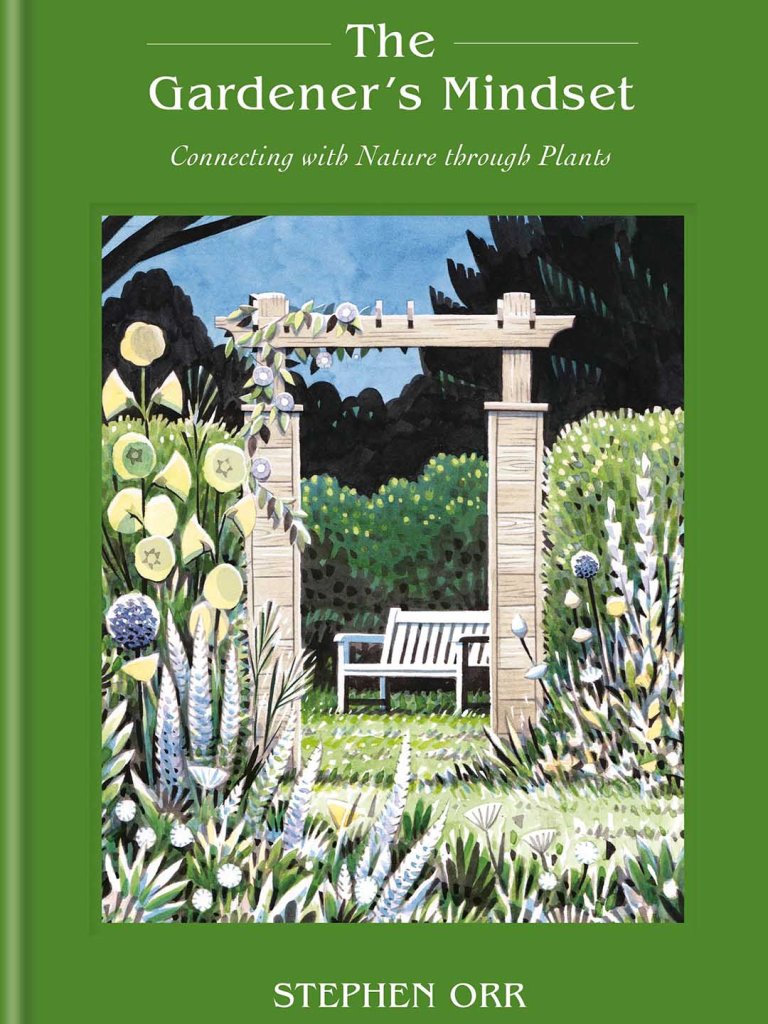
My gravel garden dreams were also nourished by the books I read when I was a young rooftop city gardener, dreaming of an in-ground garden. The late English garden writer Beth Chatto’s The Dry Garden, first published in 1978, is often credited with starting the dry or gravel gardening trend both in the UK and among the garden cognoscenti in the United States. Say her name and most avid gardeners will respond with “right plant, right place,” a phrase she popularized in the 1960s. The phrase has become a horticultural cliché, though clichés become clichés because they’re true. Her concept was simple—don’t put plants where they don’t want to grow. She was motivated by all the plants she and her husband had planted (and lost) over the years. It might seem odd that one of the seminal experts on dry gardening lived in England, but her region of East Anglia is one of the driest parts on the island, with an average of less than twenty-four inches of rainfall a year.
Chatto focused on plants from Mediterranean climates around the world where winters are cold but not frigid, and summers are hot, sunny, and dry. Not all such cool-wet-winter and dry-sunny-summer plants hail from areas around the Mediterranean Sea. They also can be found in coastal areas of South Africa, Australia, California, and parts of South America. These coastal plant communities share a common thread of resilience and toughness, whether they are in the scrubby garigues of southern France, Greece’s phrygana, California’s chaparral, the South African fynbos, or the matorral of southern Spain and South America. On Cape Cod, Massachusetts, we have our own sandy coastal heathlands made up of bearberry, black huckleberry, broom crowberry, and lowbush blueberries that grow where trees were felled long ago by early colonists or cleared by fire. Though my garden is often dry in midsummer, one of its saving graces is the amount of maritime dew that forms on the plants overnight, adding vital moisture to the growing environment—just as in the Mediterranean.
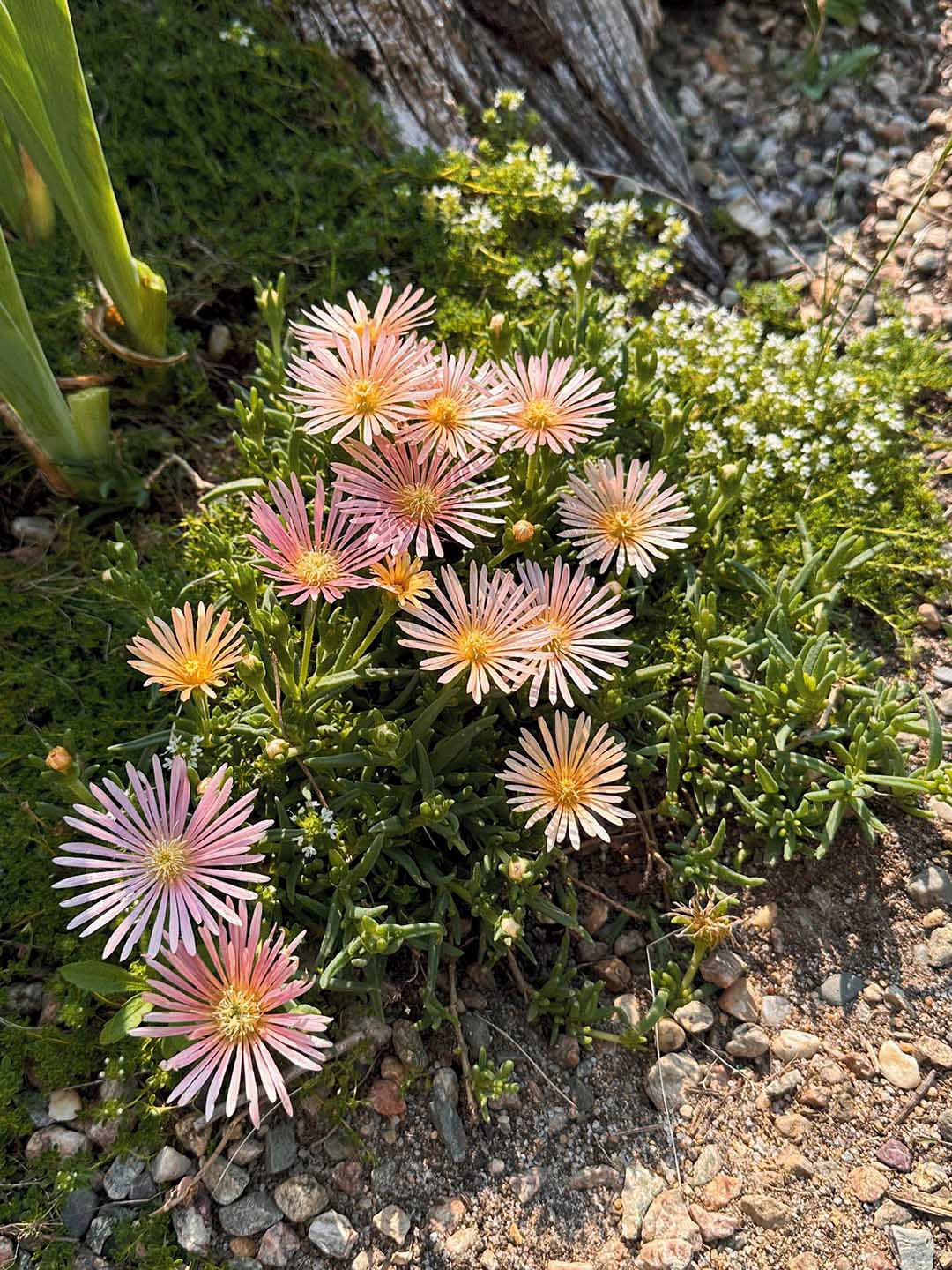
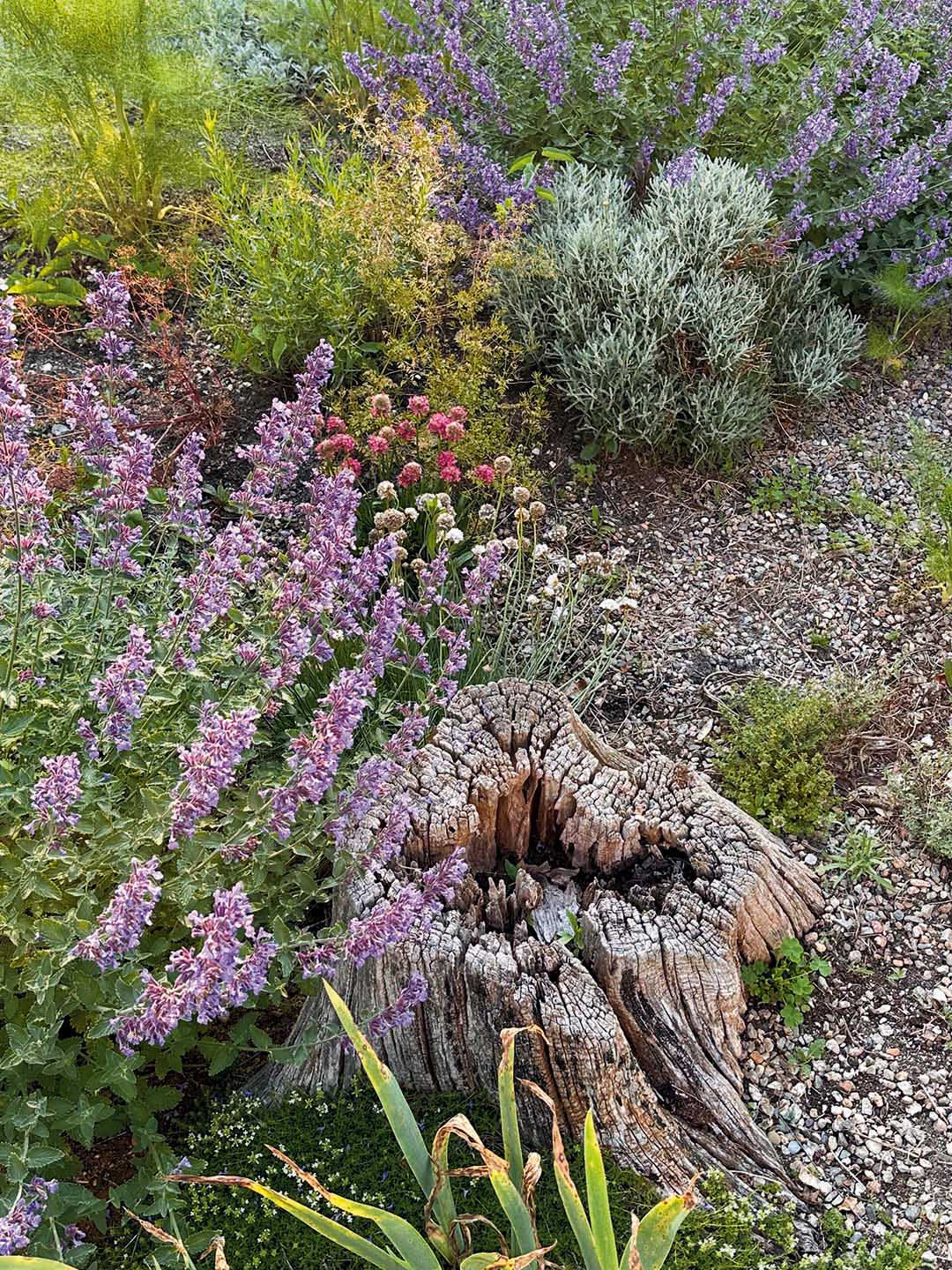
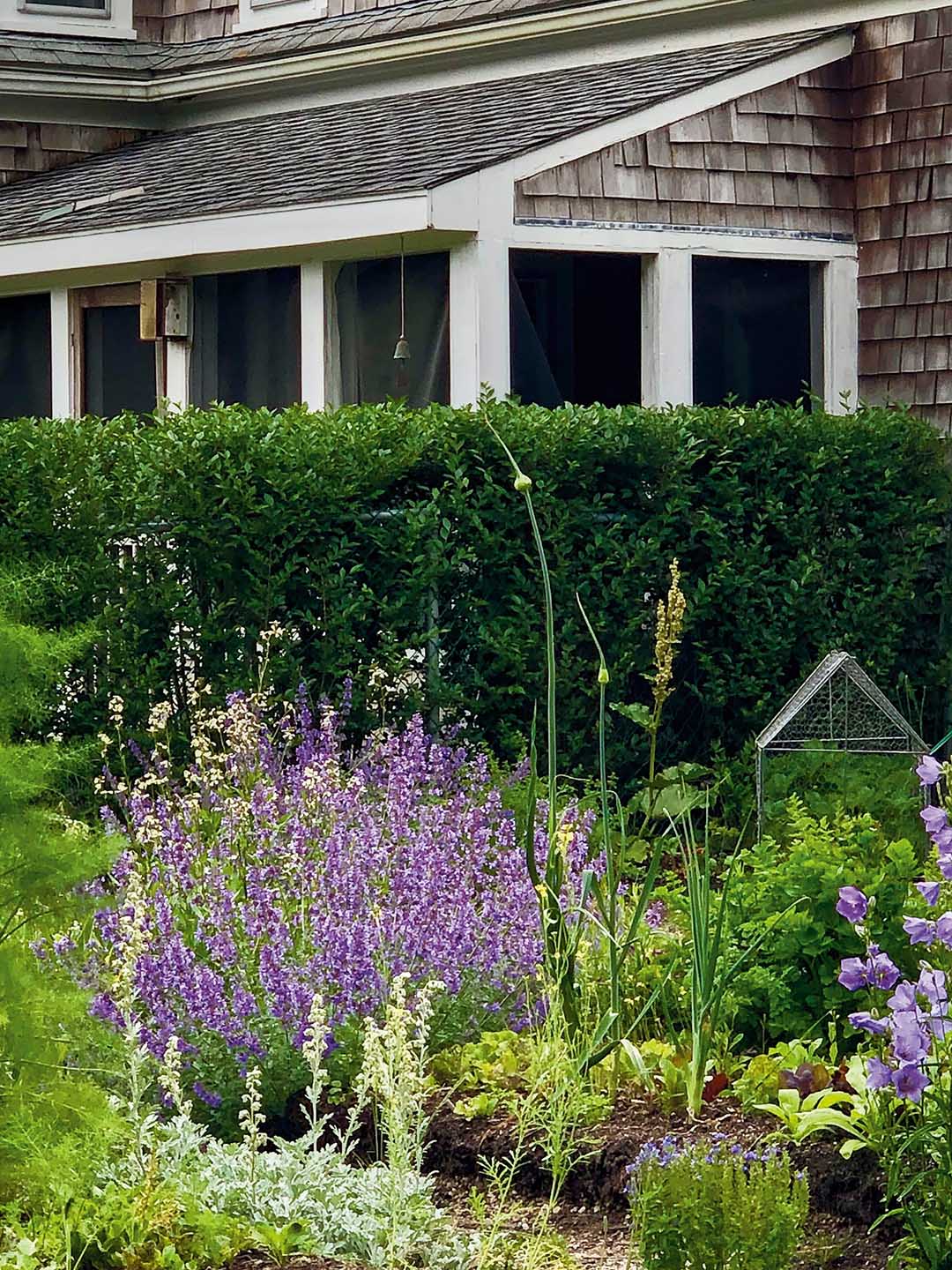
Though we have planted and learned from many things in our gravel test plot, this spring we are planning to scrape the whole space and bring in a big delivery of new gravel once finalizing a design. I am envisioning winding pathways among islands of plants, using Chatto’s triangular design concepts where a tall plant is flanked by a supporting case of lower-growing plants and ground-hugging mat varieties. It’s a look borrowed from nature with a random/not random grouping and fairly dramatic height changes that range from a few inches to several feet. Right now, it exists only on paper. While we wait for this next phase, we have been spending a fair amount of time weeding and trimming back the catmints, lavenders, and santolina, which have quintupled in size over three years. Backlit by the soft light of an Outer Cape sunset that gilds each plant’s edge, this garden that combines hard stone surfaces with delicate flowers looks like Utopia to me. I like to think Mrs. Ramsey would approve.
These waterwise gardens work well both in areas that get little rain or lots of rain. The gravel conserves soil moisture during dry spells while providing sharp drainage and absorption during downpours. During my time planning our garden, I have come across a lot of contradictory information, so I’ve tried to capture the most helpful tips here.
Tips for Creating a Gravel Garden
Assess Your Native Soil Conditions
Heavy clay retains too much water. Gravel gardens require fairly free-draining or sandy soil. But the gravel will also retain a helpful bit of moisture underneath the plant like any mulch. Many plants suitable for this type of location, such as Mediterranean varieties, prefer leaner soils over compost-rich ones.
Know the Impact Gravel Has on the Environment
Used loosely, gravel is a catchall term for all small stone. Technically, though, it is more rounded, formed naturally by the weathering action of water, whereas crushed stone is sharper-edged and machine-made in a quarry. Both gravel mining and crushed stone can cause habitat disruption and water quality issues, but crushed stone involves exponentially more processing and energy consumption to produce.
Aim for a Layer of Gravel Between Three and Four Inches
Some say six, depending on site conditions. Gravel depth is important. A thinner layer will allow bare earth or weeds to come through, while too thick of a layer can hinder plant performance and make walking or moving a wheelbarrow difficult.
Choose Your Gravel Color Wisely
Consider your local stone and evaluate the color in both a wet and dry state. Using local materials will help integrate the garden with its surroundings.
Take Into Account the Shape and Size of the Gravel
This is key for walkways. Rounded gravel can turn and slide underfoot, and larger stones can be uncomfortable to walk on barefoot. Choose angular stones with a one-sided cleave for traffic areas, as they form a tighter bond that can support foot traffic or equipment. Fine gravel ranges from dust to ⅛ inch. Pea gravel ranges from ⅛ inch to ⅜ inch. The latter is suitable for walking but can stick in shoes and travel indoors. Smaller gravels need an edging barrier to keep them in place. Medium gravel ranges from ⅜ inch to ¾ inch and can withstand more traffic because it is heavier and doesn’t move around as much. Coarse gravel, ranging from ¾ inch to 2 inches, is typically used for construction or drainage projects.
Read the Fine Print
When ordering gravel, note that the listed size in the trade reflects the filter or grate used to sort it, not necessarily the end product size. “0 to ¾” indicates a grate with ¾-inch holes, allowing material including stone dust to pass through. Specifying “¾ clean” will result in a delivery of only ¾-inch stones. “Minus” gravel products contain fine or dust-size particles, while “clean” gravel products are washed and therefore more expensive.
Avoid Landscape Fabric or Plastic Grid Systems
They are often suggested as a layer under any gravel application to suppress weeds. However, many professional gardeners know the artificial layer can make a situation worse, as weeds attach themselves to the fabric and soil health becomes compromised due to lack of aeration. I also avoid them because most products contain, or are made of, plastic, and I don’t want to add that to our environment. The correct gravel depth should help stop weeds from germinating.
Plant With Care
Planting a gravel garden in spring or fall can work better in areas with hot, dry summers. Use smaller plants, as they require less water and grow more quickly once their roots establish. Soak each plant before placing it in a generously dug hole.
Excerpted from THE GARDENER’S MINDSET by Stephen Orr. Text and photographs copyright © 2026 by Stephen Orr. Illustrations copyright © 2026 by Chad Jacobs. Photograph on page 75 by Johanna Burke. Photograph on page 198 by Nancy Iacoi. Published in the United States by Clarkson Potter, an imprint of the Crown Publishing Group, a division of Penguin Random House LLC.